False Chronicle of a Handful of Reviews
Iñárritu's latest is a divisive masterpiece that will reward repeat viewings, but it will take more than its three hour runtime to fully sink in.
By Jason Rhodes

January 8th, 2023
Tags: essay, film, Mexico, Alejandro González Iñárritu
Mild spoilers for BARDO, False Chronicle of a Handful of Truths below. I recommend understanding this context before you see the movie, but YMMV.
I think I audibly groaned when I saw the 159-minute runtime for BARDO, False Chronicle of a Handful of Truths, the latest epic from Oscar-winning director Alejandro González Iñárritu. My partner, Paola, who grew up in Mexico City, was on board for this one from the moment Iñárritu was spotted scouting locations around the Mexican capital in early 2020. I, however, was sick on the day we had tickets to see it (honest, I was) and I knew better than to ask her to wait for me. She returned from her solo screening a few hours later to emphatically announce, "This movie is FOR ME."
For her, specifically, an ex-pat Mexican-American living in Washington, DC for the past decade. In her Letterboxd review, she says, "It's a movie for immigrants. And specifically Mexican immigrants living in the US. I have experienced things that happen in this movie. I've had the same conversations. I've felt the same things."
He says the world is too fucked up. Do you have any allergies?
If I'm honest, I was pretty nervous about watching this movie after hearing her intensely personal experience with the film. How would I respond to something so uniquely targeted at the immigrant experience? To ease that tension, I decided to wait and watch it in the heart of Mexico City alongside her Mexican family—but not before a visit to Castillo de Chapultepec.
Los Niños Héroes
The Castillo de Chapultepec, a visible and memorable location appearing early in the film, sits high above Mexico City, about a 20 minute drive from my partner's childhood home. I strongly recommend making this trip the day before you watch this movie, but if for some reason you can't swing that, I hope these next few paragraphs might provide a decent amount of similar context for you.
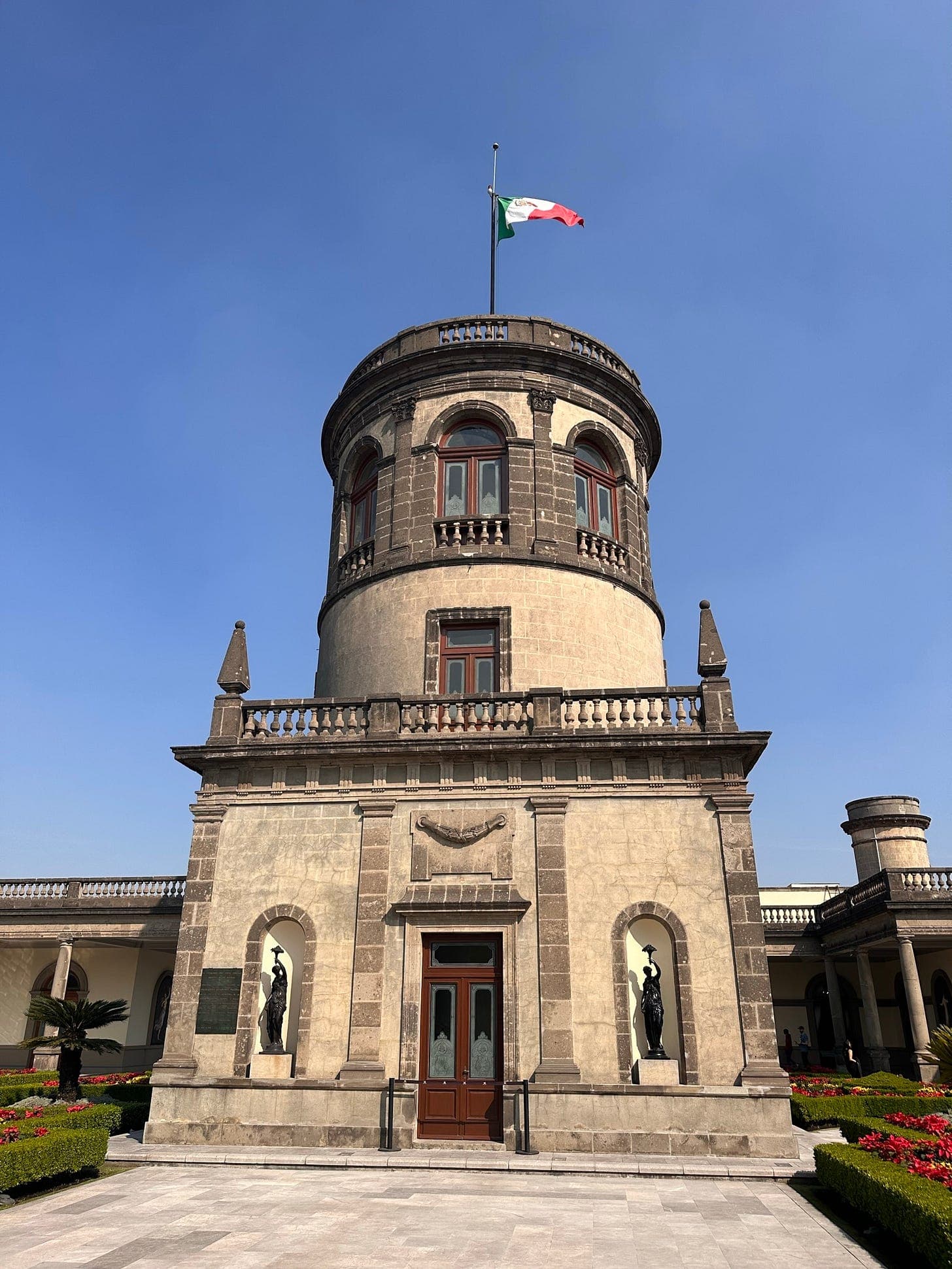
Our visit to the watchtower, or Caballero Alto, at Castillo de Chapultepec
Getting to the castle involved a short walk through the street market in El Parque Chapultepec, a delicious stop for papas de carrito drenched in Valentina, and a steep climb up Chapultepec Hill. After making our way through a detailed look at the history of Mexican independence that fills the main museum, we eventually ended up in the garden surrounding the Caballero Alto. As seen in one of the early scenes of BARDO, this is the point from which one of the niños héroes allegedly jumped to his death in September of 1847, wrapped in the Mexican tricolor flag.
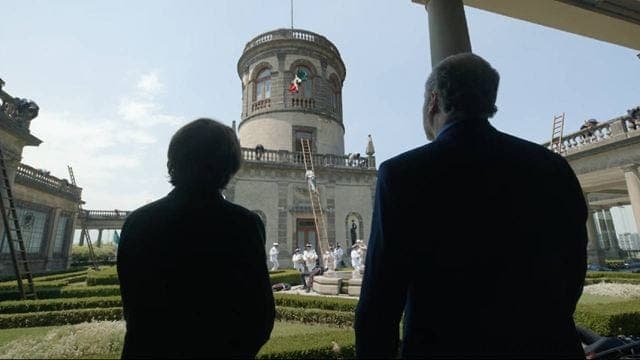
The Caballero Alto as seen in an early scene of BARDO
The Battle for Mexico City, and more specifically the Battle of Chapultepec—were key decision points in the Mexican-American war and play a key role in setting the tone of the Mexican-American relationship examined throughout BARDO. Shortly after the US forces took the castle, the capital fell, eventually leading to the end of the war and the Guadalupe Hidalgo Treaty.
That infamous treaty gave the U.S. undisputed control of Texas, California, Nevada, Utah, most of New Mexico, Arizona, and Colorado, and parts of Oklahoma, Kansas, and Wyoming. In return, Mexico received just $15 million, or about 5 cents per acre. (We didn't take it, we bought it!) The area amounted to one-third of Mexico's original territory.
Ahh, only Mexicans can turn disgraceful defeat into mythic victory!
The story of the niños héroes occupies just a brief part of this movie's massive runtime, but the reference is deeply emotional and is one I would have completely missed without added context. It's almost as if Iñárritu is making a meta-point about this Mexico/U.S. disconnect by hanging so much of the weight of this movie's starting point on this story and all of its neatly divided resonance.
When Silverio Gama, the main character in BARDO, is told by the U.S. ambassador to Mexico that they are "celebrating" the end of the Mexican-American war, he has an understandably mixed reaction. But that conversation also centers the rest of the film: Mexico and the U.S. have a fractious history. What's it like to build a life straddled entirely across that border?
A Mishmash of Pointless Scenes
There's a meta-speech in this movie where a character is giving a devastatingly harsh review of Gama's movie-within-the-movie, calling it "pretentious" and "pointlessly oneiric". In a perfect demonstration of that critique, I was forced to look up what "oneiric" means: "related to dreams or dreaming".
That's far from the only reference to dreaming that Iñárritu puts directly into his story, either, whether it's a backwards birth scene, a train filling up with water, or a gentle conversation between father and son about whether you can dream when you're already dreaming. Coupled with its almost comically pretentious title/subtitle combination, I think he wants us to understand that what we're seeing isn't entirely real. And that it's not entirely false, either.
You even put yourself in the movie, cabrón! You used historical figures to talk about yourself. Who the fuck do you think you are?
But pretentiousness is pretending to be more important than you are. Is it pretentious to simply aim for important, complex, emotional themes, even if you do it with a bit of a wink? Maybe. Several characters seem to hate Silverio Gama for betraying some aspect of living that he's meant to respect, in their opinion. This isn't how life is! There's supposed to be chronology and order, causes and consequences! I imagine Iñárritu's response would be similar to Gama's: "It's a docufiction, Luís. Humor is serious business."
Part of that humor is a circular meta-commentary about what's allowed or appropriate in stories about self-reflection. How can you know what Hernán Cortés would think, for instance? These scenes are brilliantly laid out as a mirror to the audience. You'd expect it to be easy for a story's protagonist to set himself up as superior to one of the great villains of history, but you may not expect to find valid critiques from that villain's perspective. Have you ever had a dream where your own self-critical views are presented to you from the mouths of more important characters?
Limbo
In some schools of Buddhism, bardo means an intermediate, transitional, or liminal state between death and rebirth. Despite having studied world religion at university, I wasn't familiar with that specific concept, but thankfully Gama's daughter brings up the concept rather directly at one point. It was another moment where things felt like they clicked into place for this broad, oneiric story.
BARDO, False Chronicle of a Handful of Truths
Even in the places where our identity feels the most clear and secure, maybe it's not. Am I alive or dead? Awake or asleep? Colonizer or colonized? Father or son? Activist or racist? Immigrant or native? Defender or accuser? At peace with the world or at war? Liberal or conservative? Deserving or a fraud? Believer or documentarian? Enemy or friend?
Do you think he's here with us? Can he hear us? Sure he's here. But at the same time, he's not.
I'm not an immigrant or an ex-pat, but I understand what it's like to have a foot in two very different worlds. After college, I left home and settled down only a few miles from where I grew up, but a billion light years from my religious upbringing. In Aftersun, another of my 2022 favorites, a character tells his daughter that "there's this feeling once you leave where you're from, where you grew up, that you don't totally belong there again." We're led to believe that feeling of belonging is meant to be our natural, resting state, and that we're incomplete without it.
Silverio Gama looks back at his life over the course of two and a half hours and realizes that maybe a lack of belonging is a thing he shared with more people than he realized, from tragic desaparecidos to notorious colonizers to his own multi-national children. Maybe belonging is a mirage. Gama's father tells him, "Life is just a brief series of senseless events. You must surrender to it." Maybe bardo is our natural state?
BARDO, False Chronicle of a Handful of Truths is available on Netflix.